Showing posts with label Human Nutrition. Show all posts

Thursday, 13 February 2020

Iris Publishers_Global Journal of Nutrition & Food Science (GJNFS)

Yield of Soya Paste (Okara) Influenced by Some Mechanical Parameters of an Automated Grain Drinks Production Machine


Abstract

The effect of mechanical parameters of an automated grain drinks processing machine on yield of paste (okara) was investigated in this study. Response Surface Methodology (RSM) was used to develop polynomial regression model and investigate the effect of blending blade, basket orientation and speed of rotation on yield of paste in the process of extracting soymilk from soybean. A three factors-five levels central composite rotatable design (CCRD) was used in the study. The result of the experiment revealed that blade type and speed of rotation have significant (p≤0.05) effect on yield of the paste while basket orientation has insignificant (p≤0.05) effect. It was observed that the experimental data fitted better with coefficient of determination R value of 0.9828, coefficient of correlation R-Squared value of 0.9658. The Predicted R-Squared of 0.940884 was in reasonable agreement with the Adjusted R-Squared of 0.935095. The value of adequate Precision of 19.38 also showed that the model equation can be used to navigate within the experimental range. Numerical optimization carried out with the goal of maximizing the yield of paste revealed optimum values of 5-blade assembly, basket orientation of 30° and speed of 1000rpm for consistency of 7.88 with a desirability of 0.928. The blade type and the speed of rotation were the most influential variables affecting the yield of paste. The result of this study provided standard input machine variables capable of yielding paste (okara) at various operating condition to meet the consumer’s desire.
Keywords:Blade type; Basket orientation; Mechanical; Speed; Optimization; Paste

Introduction

Soya bean paste (okara) is the by-product obtained after extraction of aqueous milk from soya bean. Large quantities of the paste are generated as by-product obtain the process of extracting the aqueous liquid from soya beans and in the production process of tofu. Several research works have reported on quantity of okara to be generated from soya beans. According to Liu [1], 1.1 pounds of okara can be generated from 1 pound of soya beans, while Riaz [2], stated that 1 kilogram of soybeans used for soymilk processing can generates between 1.4-1.8kg of okara. According to Africa Do Business Limited (2012), 1.2kg of fresh okara is produced from 1 kg of soya beans processed for manufacturing of tofu [3].
Okara was reported to have wide range of benefits, which includes excellent and abundant nutrient for livestock production, pet food and food product. Its high level of extenders and abundant nutrient makes it useful in variety of food products. It is used as food ingredient more especially in soup, salad and vegetables dishes and it has almost the same form and texture as coconut. The major constituents of okara are carbohydrate, protein, lipid and fiber. The nutrient content of okara depends mainly on soymilk processing procedure and the efficiency with which soymilk is extracted from the wet pulp. Also, the quantity of okara produced depends on the efficiency of the milling and extraction method Aguado [4]. This paper is a presentation of investigation of the interrelationship of the functional parameters of an automated grains drink production machine with yield of paste(okara). The machine was developed in the Agricultural and Bioresources Engineering department of the Federal Univesity of Technology, Minna.

For More Open Access Journals in Iris Publishers Please click on:
https://irispublishers.com/

For More Articles in Global Journal of Nutrition & Food Science

Monday, 3 February 2020

Fatty Acids Polyunsaturated as Bioactive Compounds of Microalgae: Contribution to Human Health

Global Journal of Nutrition & Food Science

Authored by Igor Fernandes

Introduction

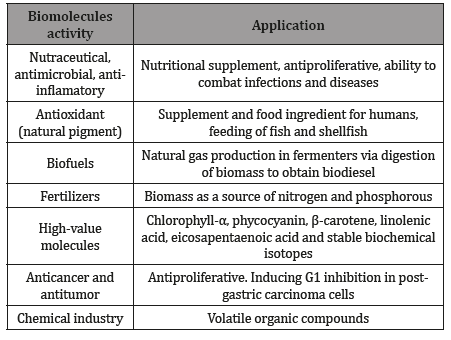
Microalgae (i.e. the prokaryotic cyanobacteria and the eukaryotic microalgae) are a wide diversity of microscopic unicellular organisms with the ability to convert solar energy into chemical energy through photosynthesis [1,2]. Moreover, this evolutionary and phylogenetic diversity means a great diversity from the point of view of the chemical composition of these organisms. Thus, this makes them extremely attractive for potential exploitation and bioprospecting as commercial sources of a wide range of biomolecules (Table 1) [2].

Table 1: Potential application of biocompounds found in microalgae biomass [7].
irispublishers-openaccess-nutrition-food-science


From among the most biotechnologically relevant microalgae it is worth highlighting the green algae (Chlorophycea) Chlorella vulgaris, Haematococcus pluvialis, Dunaliella salina and the Cyanobacteria Spirulina maxima which are widely used and commercialized, mainly as nutritional supplements for humans and as animal feed additives [1].

Microalgae are fast growing organisms which could produce a variety of compounds with various commercial uses, namely biodiesel and several compounds industrially produced [3-5]. Moreover, they can be used in the production of energy and to obtain a wide range of metabolites such as proteins, lipids, carbohydrates and minerals for health, food and feed additives and cosmetics [1]. Currently, microalgae play an important role in aquaculture, are used in the enhancement of the nutritional value of food and animal feed due to their chemical composition and can be incorporated into cosmetics [1]. Additionally, microalgae are suitable for use in human health as they are a source of bioactive compounds such as long chain polyunsaturated fatty acids (PUFA), sterols, sugars, pigments, carotenoids, phycobilins and vitamins [1,2,6]. Furthermore, polyunsaturated fatty acid oils are used to obtain nutritional supplements whereas proteins and pigments are important as natural dyes and as compounds which exhibit properties well desired by the pharmaceutical industries to treat certain diseases [1,7]. On the other hand, the production of hydrocarbons and saturated and monounsaturated fatty acids by microalgae strains are appropriate for biodiesel production [4,8].
Unlike terrestrial plants, microalgae bring forward several advantages such as a larger biomass production in shorter periods of time which brings out great health benefits, the requirement of less amounts of water and the absence of the application of fungicides, herbicides or pesticides during their cultivation [3]. Furthermore, from the environmental point of view, microalgae have great impact on the reduction of greenhouse gases and consequent decrease of global warming, since the production of 1Kg of dry algal biomass consumes around 1.83Kg of CO2 [3].

Importance of Fatty Acids in Health

Marine microalgae are considered as a renewable source of bioactive lipids with a high proportion of polyunsaturated fatty acids (PUFAs), which have demonstrated to be effective in the prevention or treatment of several diseases [1]. Microalgae exhibit a high percentage of lipids, in which represent approximately 30-50% of the total weight of biomass [7]. They are suppliers of long-chain PUFAs such as linolenic acid, arachidonic acid, eicosapentaenoic acid (EPA) and docosahexaenoic acid (DHA) [2,9]. EPA and DHA are vital for keeping the bio membranes and cellular functions (e.g. cell signaling), whereas proteins are important for the primary metabolism of microalgae as biological catalysts responsible for crucial reactions that have effect on cell growth [10-12].

PUFAs, namely omega 3 PUFAs such as α-linolenic acid (C18:3n-3), EPA (C20:5n-3), docosapentaenoic acid (DPA, C22:5n-3) and DHA (C22:6n-3), have been shown to be effective in the prevention and treatment of cardiovascular diseases, cancer, type 2 diabetes, inflammatory bowel disorders, asthma, arthritis, kidney and skin disorders, depression and schizophrenia [1]. Additionally, the essential fatty acids and the long chain PUFAs are crucial as essential components of the biological membranes and precursors of a wide variety of signaling molecules (e.g. leukotrienes, eicosanoids and thromboxanes), which are responsible for multiple physiological and pathological responses [13-15].

Notwithstanding the multiple advantages offered, humans do not have the ability to synthesize these compounds, so their dietary intake is crucial for human health. Furthermore, research regarding the relations between diet and diseases correlate the dietary intake of these fatty acids with the prevention of cardiovascular diseases and cancer, reduction of coronary heart disease, decrease of mild hypertension and alleviation of the symptoms of rheumatoid arthritis [6,13,14,16].

The knowledge of the ability of PUFA-rich oil from phototrophic microalgae, which is relatively expensive to grow, to compete in the marketplace with the heterotrophically grown algae and fungi, as well as, other PUFA rich oils such as fish oil, either as high-value nutritional supplements or in the lower value market as a fish oil replacement in animal nutrition is not well known [2]. Under these circumstances, the ‘vegetable’ nature of algae may be a marketing differentiator [2]. To upgrade the future production of algal oils and the combination of diverse improvements in lipid productivity through isolation of new species, strain selection, genetic manipulation and engineering, and/or optimization of culture conditions with economics of scale is essential [2].

Acknowledgment

This study was supported by project M1420-01-0247- FEDER-000023 of Instituto de Desenvolvimento Empresarial da Madeira (IDE, IP-RAM).

Conflict of Interest


No conflict of interest.


For More Open Access Journals in Iris Publishers Please click on:

Wednesday, 3 July 2019

Beetroot Based ORS for Treatment of Cholera

Global Journal of Nutrition & Food Science

Cholera, caused by the bacteria Vibrio cholerae, can be lifethreatening but it is easily prevented and treated. It is caused by eating food or drinking water contaminated with Vibrio cholerae.V. cholerae was first isolated by Italian anatomist Filippo Pacini in 1854. Later Robert Koch publicized the knowledge of cholera. The bacterium’s natural habitat is brackish or saltwater, and globally, cholera cases have increased steadily since 2005.
Vaccination and good hygiene are mainstay of cholera prevention. Treatment of cholera consist of oral or intravenous solutions to replace lost fluids. Antibiotics are not part of emergency treatment for mild cases; however, they can reduce the duration of diarrhea by half and also reduce the excretion of the bacteria, thus helping to prevent the spread of the disease.
Oral Rehydration Salts (ORS) consists of a balanced glucoseelectrolyte mixture recommended and distributed by UNICEF and WHO as treatment of clinical dehydration throughout the world. ORS is a method of fluid replacement which involves drinking water with modest amounts of sugar and salts, specifically sodium and potassium.
Food-based oral rehydration solution shown to be better than glucose-ORS as treatment of diarrhoea in children in rural Bangladesh. Here we are suggesting beetroot-based ORS as cholera treatment. Beetroot is of exceptional nutritional value. It is varieties of Beta vulgaris grown for their edible taproots and leaves (called beet greens). The greens of beetroot, which are rich in calcium, iron and vitamins A and C. Beetroots are an excellent source of fiber, and folic acid, manganese and potassium. The greens should not be overlooked. The beetroot is eaten boiled, roasted, or raw.
Raw beetroot is 89% water, 11% carbohydrates, 3% protein, and less than 2% fat. In every 200-gram amount providing 86 calories, raw beetroot is a rich source of folate and a moderate source of manganese, with other nutrients having insignificant content. Beetroot based ORS can be prepared by cooking it with added salt combined with ORS.

For More Open Access Journals in Iris Publishers Please click on:

Thursday, 22 November 2018

Maternal Knowledge on Complementary Feeding Practice and Nutritional Status of Children 6-23 Month in Jigjiga Town

Nutrition & Food Science


The purpose of this study was to determine mothers knowledge on complementary feeding practices and relate this to the nutritional status of their children aged 6-23 months. The study adopted a cross-sectional analytical study design and was carried out at the kebele 05 in Jigjiga town among the randomly sampled 110 mothers and their children. A researcher-administered questionnaire was used to collect data. Data was entered and analyzed using SPSS version 20 ENA [1]. Anthropometric measurements were analyzed using Microsoft Excel. The respondents were mostly young (mean age 27.7±4.7 years), married (87.3%), housewives (70%) with mainly primary school level of education (48.2%). The main sources of income for most households were business (48.6%) and casual labor (31.8%). Mothers had high knowledge on complementary feeding practice (90%) out of the 20 knowledge questions. All (100%) the children aged 6-8 had been introduced to solids, semi-solids and soft foods. Majority of the breast-fed children received minimum meal frequency were 6-8 months old (86.7%) and 9-23 months old (90%) unlike the non-breast fed children (80%). Overall, 52.7% of all the children were stunted, 49.1% wasted and 43.6% underweight. Maternal knowledge on complementary feeding was significantly associated with nutritional status of their children. Mothers knowledge on feeding the sick and recovering children was related to underweight in children. The same was true of mothers who knew that a child’s main meal should be diversified. Mothers knowledge on complementary feeding practices was not significantly related to her complementary feeding practices (p>0.05). Nutrition programme should pay attention to cultural beliefs on infant and young child feeding.